Carbon sequestration and GHG mitigation
July 30, 2026
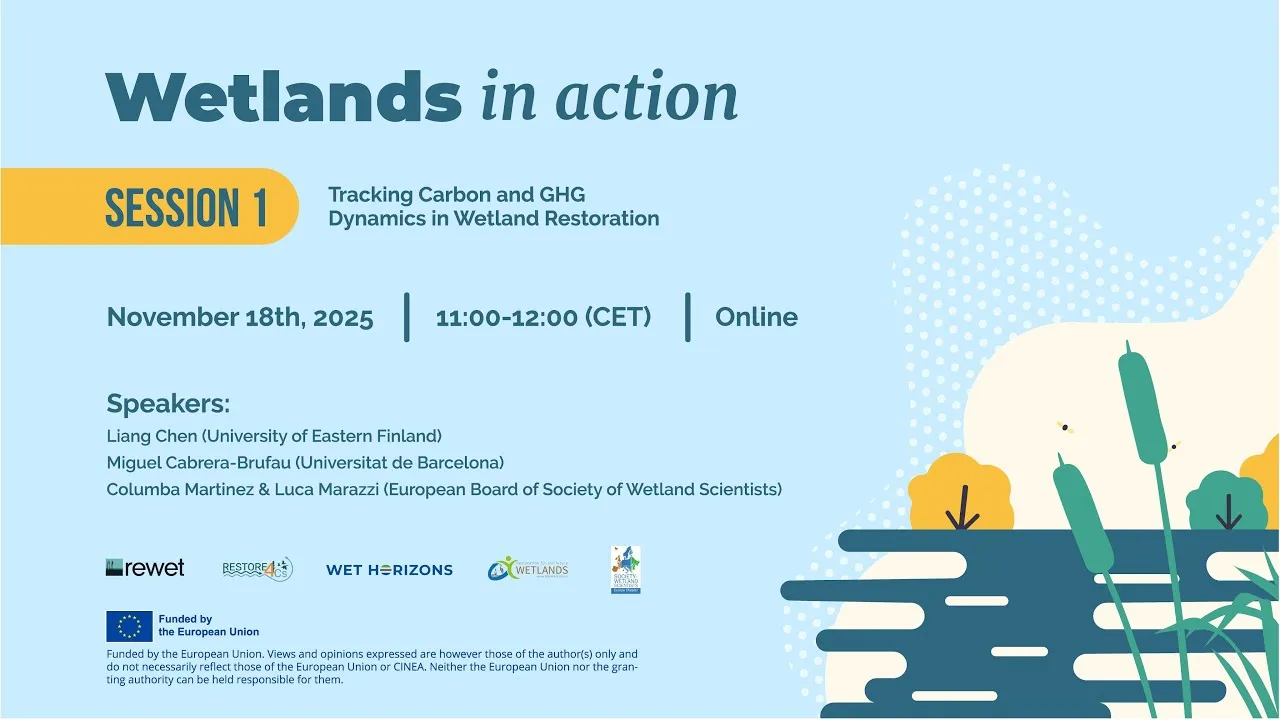
Tracking Carbon and GHG Dynamics in Wetland Restoration – Joint webinar Horizon ALFAWetlands, RESTORE4Cs, REWET, Society of Wetlands Scientists
Read more


Ria de Aveiro is a large and dynamic coastal lagoon on the north-western Atlantic coast of Portugal, shaped by tidal exchange, river inputs and centuries of human use. It encompasses three domains of aquatic ecosystems (freshwater, transitional waters and coastal marine waters), with multiple interactions and interdependencies of aquatic-terrestrial processes. The freshwater system supports the confluence of the Vouga River with the the Baixo Vouga Lagunar (coastal lagoon) and the Pateira de Fermentelos wetland – a Ramsar site which stands as one of the largest natural freshwater lagoons in the Iberian Peninsula. The Baixo Vouga Lagoon encompasses three landscape units: the “Bocage”, the open agricultural fields (large agricultural plots without tree vegetation) and the wetlands, mainly reed beds.
The biological richness of this system is mainly due to the presence of Zostera noltei meadows and to the existence of one of Europe’s largest continuous salt marshes (composed of numerous species, including Spartina maritima and Juncus maritimus). Small-scale fisheries – including the collection of shellfish and bait for fishing and aquaculture – and other cultural practices, namely seagrass harvesting (used as an agricultural fertiliser) and salt pond construction have sustained this highly diverse landscape.
Yet, as traditional practices have declined and industrial activity intensifes, the Ria has been subject to growing pressures, ranging from hydromorphological alterations and sediment imbalances to habitat degradation and increasing effects of climate change, such as sea-level rise, altered hydrodynamics and the presence of exotic species with invasive behaviour. These pressures have made ecological restoration an urgent priority, while also highlighting the complexity of planning and decision-making in such a multifunctional system.
© Photos and video-documentary by LifeWatch ERIC/ Università del Salento


Over the last decade, the collaborative platform LTsER Ria de Aveiro has brought together different research projects conducted in the area by promoting a transdisciplinary approach, with active participation of key players, not only from the region, but also from organisations at the national level, in order to co-develop adaptive management scenarios using GIS-based models.
One of the projects contributing to this platform has been the Horizon RESTORE4Cs. In this project, Ria de Aveiro was selected as the Portuguese case pilot project, with the goal of strengthening knowledge, supporting informed dialogue and improving societal and institutional readiness for coastal wetland restoration. Rather than implementing restoration solutions, the project has focused on generating scientific evidence, exploring prospective scenarios and fostering interaction between science, policy and practice, in close articulation with other ongoing initiatives in the region.
Scientific activities contributed to a better understanding of key ecological processes, particularly greenhouse gas dynamics and carbon pathways in coastal wetlands, with special attention to seagrass meadows dominated by Zostera noltei. Modelling and mapping approaches were used to explore land-use and restoration scenarios, helping to illustrate how changes at catchment and lagoon scales may influence ecosystem functioning and service provision. In parallel, policy and governance analyses examined how national and European frameworks shape restoration opportunities, identifying both enabling conditions and constraints.
RESTORE4Cs activities have been closely linked to concrete restoration actions carried out in the Ria de Aveiro through collaboration with other European projects, namely the Mission Ocean project A-AAGORA, REWRITE and the LIFE project SeagrassRiaWild. These included salt marsh restoration using Atriplex portulacoides, with plants propagated at the University of Aveiro and planted in the Casqueira saltpan, as well as active restoration of seagrass meadows using Zostera noltei in different areas of the lagoon. These actions involved researchers, students, volunteers and practitioners, reinforcing knowledge transfer between scientific research and hands-on practice, while remaining outside the direct implementation scope of RESTORE4Cs.
Stakeholder engagement played a central role at the case pilot, which has contributed to the development of the European Community of Practice for Restoring Wetlands. Interactions involved environmental authorities, municipalities, protected area managers, NGOs, research institutions and other relevant actors. Participatory workshops and discussion moments supported the co-development of prospective restoration scenarios and facilitated dialogue on feasibility, trade-offs and governance challenges. These interactions also helped identify where scientific outputs needed further localisation or simplification to be more useful for management contexts.
Activities at this site have also supported the development and refinement of the European Coastal Wetlands Interactive Platform, by providing site-specific evidence, stakeholder feedback and insights from a complex lagoon system. The challenges, discussions and prospective scenarios explored in Aveiro were integrated into the project’s wider knowledge base, ensuring that the final products reflect real policy and management contexts.
Building on this contribution, theInteractive Platform responds to national policy-makers’ needs by offering structured, evidence-based information on coastal wetland functioning, carbon pathways and restoration readiness. Developed through the aggregation of experiences across all case pilots, including Ria de Aveiro, these products support strategic reflection, policy alignment and informed decision-making at national and European levels

A key synthesis moment for Ria de Aveiro was the RESTORE4Cs Final Transfer Event, held in December at the University of Aveiro. The event brought together researchers and institutional representatives to reflect on project results, test the usability of an interactive online platform developed in collaboration with a Mission Ocean project, and discuss future pathways. The event also marked the launch of the Portuguese case pilot book “Restaurar Zonas Húmidas Costeiras para um Futuro Sustentável: A Ria de Aveiro como Área-Piloto”, which was widely recognised as an accessible and lasting synthesis of scientific knowledge, management challenges and restoration perspectives.
Among the results, stakeholders showed particular interest in integrative outputs that support strategic reflection rather than immediate implementation, including prospective scenarios, policy-relevant syntheses and participatory products. Looking ahead, the agreed Action Plan focuses on refining tools to better support local decision-making, maintaining stakeholder engagement, strengthening alignment with national and European policy processes, and continuing collaboration with other projects active in the Ria de Aveiro. Together, these outcomes contribute to building long-term capacity, trust and readiness for coastal wetland restoration in the region.
If you wish to learn more about these activities, please visit:

July 30, 2026
Read more
July 30, 2026
Read more