Carbon sequestration and GHG mitigation
July 30, 2026
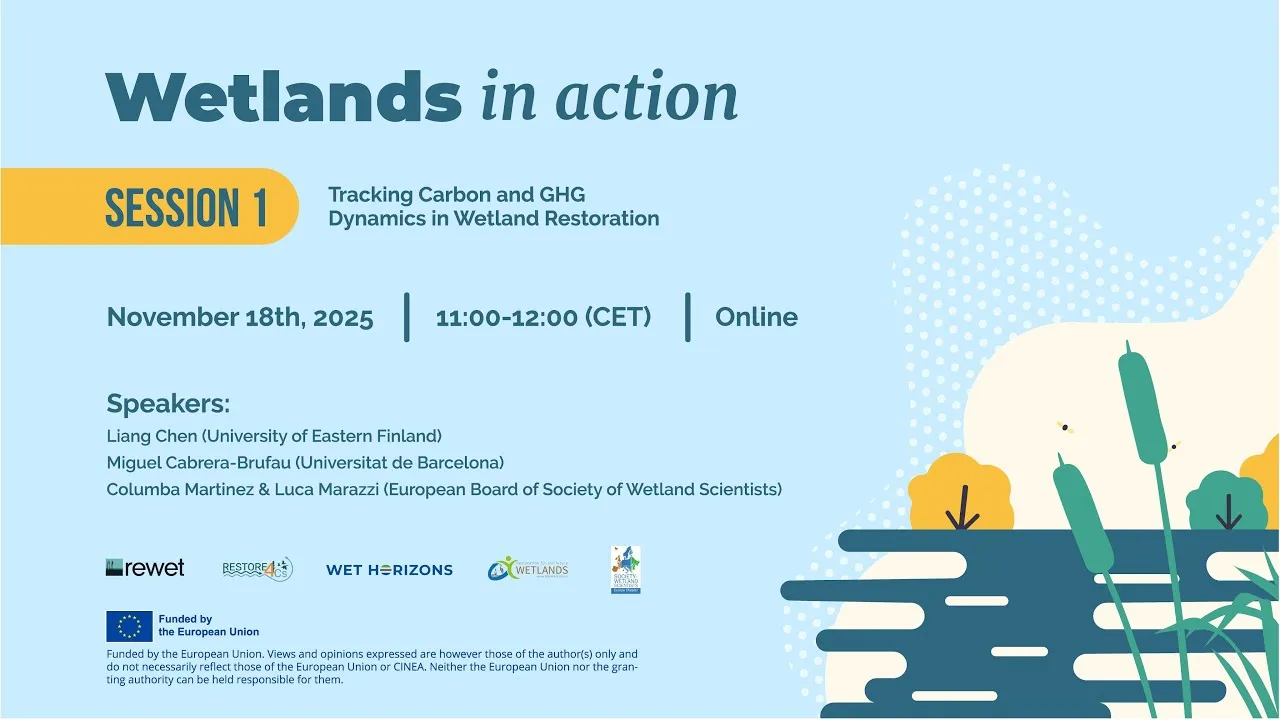
Tracking Carbon and GHG Dynamics in Wetland Restoration – Joint webinar Horizon ALFAWetlands, RESTORE4Cs, REWET, Society of Wetlands Scientists
Read more


Recently, a court ruling has demanded the reconstruction of the Carasuhat dyke in Romania, which had breached incidentally in 2023 leading to the passive restoration of approximately 1000 hectares of wetlands. The new legal decision creates a significant financial gap, especially for the Managing Authority of the Biosphere Reserve, intensified by farmers’ claim for compensation to use the land for conservation purposes. This controversy was at the core of a participatory workshop held with the Romanian stakeholders of the Danube Delta in October 2024, which aimed at collecting information on key challenges and preferences in terms of solutions and management strategies. Among the involved stakeholders were representatives of the environmental authorities, municipalities, protected area managers, NGOs, research institutions, fishermen, and other relevant actors. In December 2025, the European Community of Practice for Restoring Wetlands (ECoP), organised a workshop in response to the need unanimously raised by the stakeholders of the Danube Delta in Romania for sustainable finance mechanisms.
The online workshop, coordinated by the Mediterranean Ramsar Regional Initiative (MedWet) with participation of the University of Bucharest, the Danube Delta Biosphere Reserve in Romania, the Managing Authority and WWF Romania, fostered a transnational exchange on solutions for the long-term financing of wetland restoration.
A review of existing wetland restoration projects across Europe, as part of the activities of the Community of Practice, shed light on the internationally recognised experience of the Prespa-Ohrid Nature Trust (PONT) in financing large-scale restoration in the transboundary wetlands of the Prespa-Ohrid region between Greece, Albania and North Macedonia. Following the invitation of MedWet, the PONT Trust accepted to share its experience in sustainable finance with the stakeholders of the Danube Delta.
The workshop, organised in connection with the closing event at the Romanian case pilot, offered a synthesis of the results of an analysis of finance schemes in RESTORE4Cs by Wageningen University and Research. This session was followed by a presentation of PONT’s business model by Mirjam de Koning, CEO of PONT, reflecting on the lessons learned in its ten years of existence. In this period, PONT has increased its funding for restoration and conservation by 300%, having secured over €3 million per year in drawdowns until 2040. One key recommendation shared by PONT was the establishment of a Conservation Trust Fund (CTF) which is bound to a geographically specific region.
The workshop also supported a dialogue between the managing authority of the Danube Delta Biosphere Reserve and the Galicica National Park in Macedonia – one of the beneficiaries of PONT, represented by Andon Bojadzi (Head of Conservation), to share challenges and strategies for funding restoration. Notably, the experience of the Galicica National Park showed how funding diversification has made the park more economically independent and less reliant on finance from exploitative activities such as forestry.
Encouraged by these experiences, the stakeholders of the Working group – Towards a long-term sustainable finance mechanism in the Danube Delta proposed to create a new Working Group of the Community of Practice, led by the team of University of Bucharest and with the participation of the Management Authority of the Danube Delta Biosphere Reserve, WWF Romania, the Horizon project RESTORE4Life and operational support from MedWet.
This new Working Group will work towards creating a long-term vision for finance in the Danube Delta in Romania building on diverse funding sources. Moreover, the Working Group will aim to utilise the European Coastal Wetlands Interactive Platform, which makes possible to prioritisethe areas to be restored based on the potential benefits and cost-effectiveness.
The Danube Delta, one of Europe’s largest and well preserved wetland area, is recognized as a Biosphere Reserve, UNESCO World Heritage Site and a Ramsar site. The deltas’ territory is a complex network of waterways, marshes, islands, and lakes, sprawling over 5,800 square kilometers, supporting exceptional biodiversity and providing important ecosystem services. Conservation efforts included the establishment of the protected area, international cooperation works for conservation and knowledge as well as pilot restoration projects aimed at reversing habitat degradation.
However, challenges such as fragmented land-ownership, limited enforcement of environmental regulations, and competing economic interests continue to hinder large-scale restoration. Within the RESTORE4Cs project, rates of C-storage and greenhouse gases (GHG) exchanges (particularly carbon dioxide (CO2), methane (CH4) and nitrous oxide (N2O) were seasonally measured, in wetlands of different status (preserved, altered and restored) in order to understand their role in carbon dynamics.
The Final Event for the Danube Delta case pilot of the Horizon RESTORE4Cs project brought together researchers, NGOs and institutional representatives to discuss the potential for applying the project findings, tools and results.

Next steps for the Danube Delta case pilot:
1) Refining modelling outputs to better support local-scale management decisions:
a) Apply the modelling tools to generate results for specific, local sites within the Danube Delta.
b) Generate scenario-based outcomes or quantitative estimates for active restoration tools to demonstrate their potential impact and value.
2) Expanding stakeholder engagement activities
a) Incorporate examples and information relevant to different stakeholder groups.
3) Identifying potential pilot areas for demonstrating restoration approaches.
a) Initiate research or tool development to provide evidence on the effectiveness of active restoration measures in the Danube Delta.

© Photos and video-documentary by LifeWatch ERIC/ Università del Salento
July 30, 2026
Read more
July 30, 2026
Read more